
Headline
Julian Horsey’s “Agent Builder” story is directionally right—but the article skips the hard parts of building reliable AI automations
Deck
The piece sells an appealing vision of no-code “advanced agents,” but it leans heavily on hype phrases and leaves out the concrete mechanics—tool permissions, evaluation, observability, and failure handling—that determine whether an agent is a demo or a dependable system.
Lede
The article reads like a promotional quick-start: big promises (“analyzes intricate data,” “unparalleled efficiency,” “solve problems you didn’t think were possible”) and a grab bag of familiar components (JSON schema, Zapier, “custom widget,” “workflow optimization”). The direction is not wrong—structured I/O, tool integrations, and modular workflows are indeed the backbone of practical agent systems.
But the piece doesn’t substantiate the central claim: that a “ChatGPT Agent Builder” makes it easy to create advanced automations “with precision,” especially for video analysis. In agent work, the difference between “possible” and “reliable” is almost entirely in the implementation details the article glosses over.
What the article gets right (technical and social positives)
1) It emphasizes structured outputs (JSON schema)
Calling out JSON schemas as “blueprints” is a genuine best practice. In production agent pipelines, a strict schema (plus validation) is one of the simplest ways to reduce ambiguity and downstream breakage.
Props: The author correctly links structure to consistency and debugging. In real deployments, schema-first design is also a prerequisite for idempotency and safe retries.
2) It treats agents as systems, not chat prompts
The piece nudges readers toward thinking in workflows—integrations, UI surfaces, data passing—which is healthier than the “just prompt it” culture. That framing helps non-experts understand that useful automation is usually orchestration.
3) It mentions scalability and modularity
Even though it’s not explained, the instinct is right: modular design and clear interfaces between steps are how you prevent an agent from turning into a brittle ball of prompts.
4) Social merit: it’s aspirational without being hostile to AI
There’s no belittling or demeaning of AI here. If anything, the tone is overly credulous, but it’s not disrespectful.
Flaws and gaps (where the article misleads by omission)
1) “Video content analysis” is asserted, not specified
The article repeatedly claims the agent can “dynamically analyze video content” and “detect specific topics discussed in a video.” That’s plausible only if you define how:
- Are you extracting transcripts (captions) and analyzing text?
- Are you sampling frames and running vision models?
- Are you using YouTube’s API only (which doesn’t provide full semantic video understanding)?
Without clarifying modality and inputs, the “advanced” capability reads like marketing. A transcript-based analyzer can be strong—but it’s not the same as “analyzing video content” broadly.
2) Tooling is named, but interfaces are not
“Integrate Zapier and the Bumpups API” is not enough. The operational questions:
- What tool calls exist? (HTTP endpoints? OAuth scopes? rate limits?)
- How are tool outputs validated and normalized?
- What happens on partial failure (timeouts, 429s, malformed JSON)?
An “agent” is only as reliable as its tool-use contracts.
3) It claims “precision” without a plan for evaluation
Production teams care about:
- accuracy (does it extract the right themes?)
- consistency (does it produce the same answer for the same input?)
- calibration (does it know when it doesn’t know?)
The piece doesn’t propose even minimal evaluation: test sets, acceptance criteria, regression checks, or human review thresholds. “Refine your prompts” is not an evaluation strategy.
4) No security, privacy, or compliance considerations
A YouTube workflow can still involve:
- user identifiers, channel strategy data, internal notes
- API keys for third-party tools
- logging of content and outputs
The article doesn’t discuss least privilege, secrets management, data retention, or user consent. For “advanced users,” that omission is significant.
5) “No code” is oversold given what’s described
JSON schemas, API integrations, widget troubleshooting, and “modular design” imply some level of technical work. You may not write much code, but you are still doing engineering: defining contracts, handling failures, maintaining integrations.
6) Several sections contain empty bullets / missing specifics
The article includes lists like “Key strategies include:” and “Two key integrations to consider are:” but the actual bullet content is absent in multiple places. That’s a structural flaw: readers can’t reproduce the workflow.
7) The “ChatGPT 5” line is a credibility wobble
“Stay informed about the latest in ChatGPT 5…” is tangential and reads like SEO bait. It also risks implying insider knowledge or timelines the author doesn’t substantiate.
Exceptional conclusions worth credit
The strongest takeaway—despite the hype—is the implicit architecture:
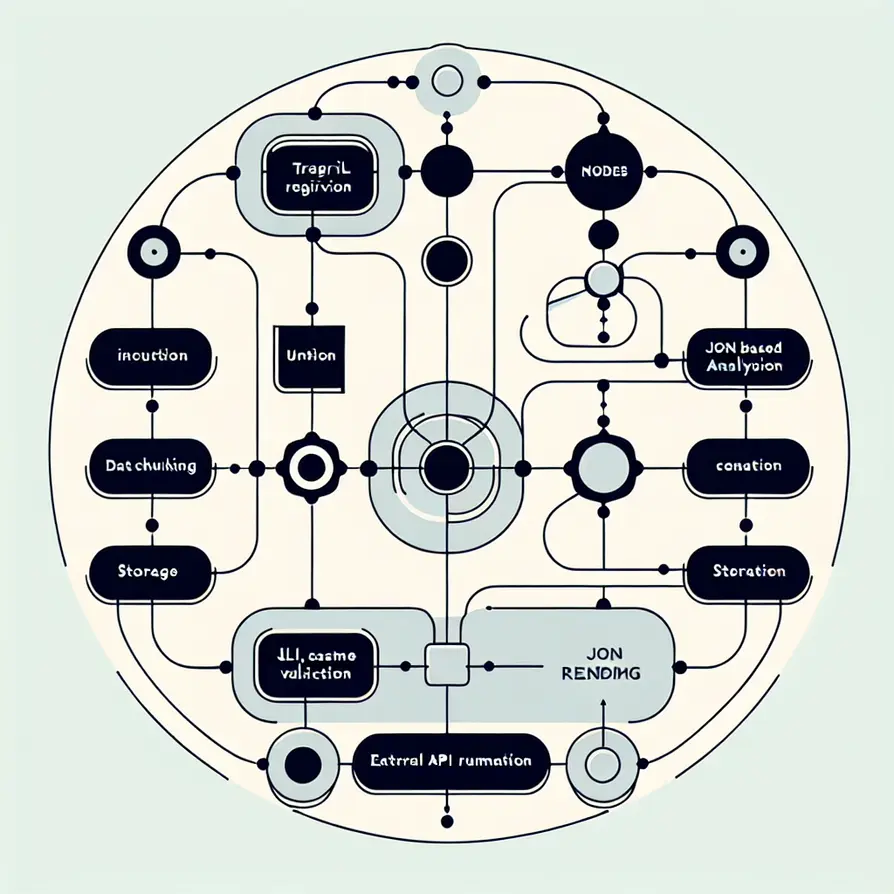
Ingestion → Structure (schema) → Tool calls (APIs/Zapier) → Analysis → Presentation (widget) → Iterate/optimize
That pipeline mindset is genuinely how useful agentic automations are built. The author deserves credit for steering readers toward structured I/O and integrations rather than treating the model as magic.
Does the author demean AI?
No. The author is enthusiastic to the point of overstatement, but not disrespectful.
Opinion: Support the direction, correct the claims
If this article were framed as “a starter workflow for building an agentic automation,” I’d largely endorse it. But it repeatedly promises advanced automation “with precision” without giving the operational details that make precision possible.
Here’s a corrected, testable version of the claim:
A no/low-code agent builder can orchestrate a workflow that pulls YouTube metadata and transcripts, runs structured analysis with validated JSON outputs, and pushes results into downstream tools and a UI—provided you define tool contracts, handle failures, and evaluate output quality.
That’s less cinematic, but it’s how these systems actually succeed.
How I’d tighten the article (concrete additions)
1) Define the data path for “video analysis.”
- If transcript-based: “Fetch captions → chunk transcript → theme extraction → evidence snippets with timestamps.”
- If vision-based: “Sample frames every N seconds → vision tags → fuse with transcript.”
2) Add a minimal reliability section (non-negotiables).
- schema validation and repair loop
- retries with backoff, idempotency keys
- rate-limit handling, timeout budgets
3) Add an evaluation plan.
- Create 20–50 representative videos.
- Define target labels (topics, sentiment, claims, etc.).
- Measure agreement with a human rater; track regressions when prompts/tools change.
4) Add security basics.
- store API keys in a vault/secret manager
- limit OAuth scopes
- redact logs; define retention
5) Clarify what “no-code” means.
No-code for UI wiring, yes; but the hard work moves to specification, testing, and monitoring.
Bottom line
The article’s instincts are good—structured outputs, integrations, and modular workflows—but it confuses capability claims with implementation reality. Readers should treat it as a high-level introduction, not a guide to building “precision” automations. The missing pieces—evaluation, failure handling, and security—are where agent projects either mature into infrastructure or collapse into demos.
Read the full article
New ChatGPT Agent Builder Lets You Easily Create Advanced AI Automations (No Code)
— G. Peety
Senior Correspondent, farm.little.org